Solar Eclipse in Portugal: A Guide for Silver Coast Residents and Visitors
On Wednesday, 12 August 2026, residents and visitors on Portugal’s Silver Coast will be treated to one of the year’s most remarkable natural events.
A deep partial solar eclipse will be visible throughout the region, with approximately 95 to 96 per cent of the Sun covered by the Moon. If the weather cooperates, the Silver Coast’s open Atlantic horizon could provide an excellent setting for watching it.
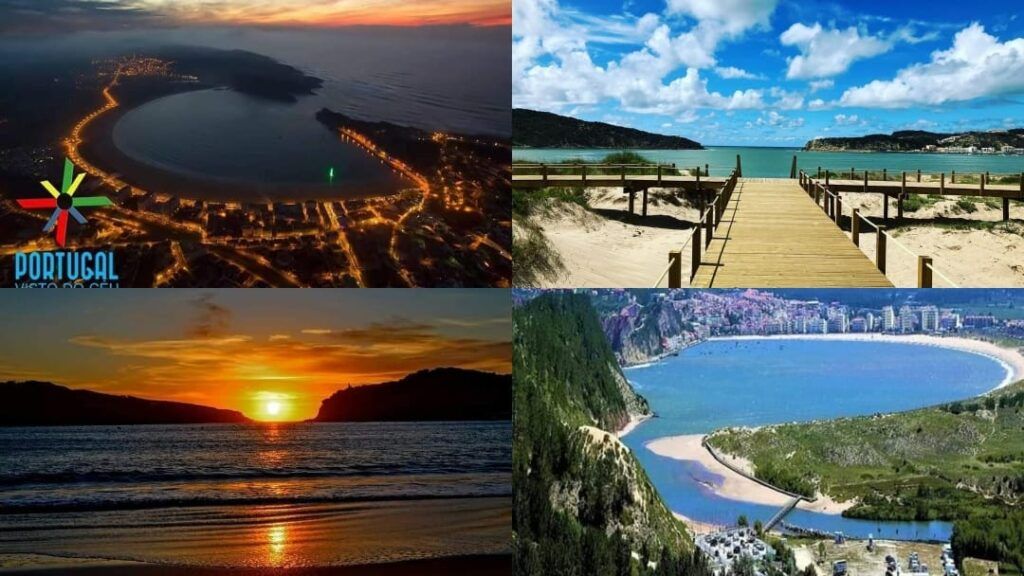
Whether you live in Nazaré, São Martinho do Porto, Caldas da Rainha, Óbidos, Peniche, Alcobaça or elsewhere in the Oeste region, this is an evening worth reserving in your calendar.
When will the eclipse be visible?
The exact timing varies slightly by location, but across the Silver Coast the eclipse will last for approximately one hour and 50 minutes.
For Caldas da Rainha, the expected local times are:
- Partial eclipse begins: 6:38 pm
- Maximum eclipse: 7:35 pm
- Partial eclipse ends: 8:28 pm
Around 95.8 per cent of the Sun is expected to be covered in the Caldas da Rainha area. In nearby Leiria, maximum eclipse will occur at approximately 7:34 pm, with around 96 per cent coverage.
All times are local Portuguese summer time, known as WEST. Check the detailed calculation for Caldas da Rainha.
Will the eclipse be total on the Silver Coast?
No. Although this is classified globally as a total solar eclipse, it will remain partial on the Silver Coast.
The only part of Portugal where totality may be experienced is a very narrow area in the far northeast of the country, between the villages of Rio de Onor and Guadramil in the Montesinho Natural Park, near Bragança. Even there, totality will last only a few seconds. Bragança Municipality identifies this as Portugal’s total-eclipse zone.
For those prepared to travel, this remote corner of Portugal offers the possibility of seeing the Sun completely covered. However, visitors should expect considerable interest, heavy traffic and limited parking.
Travelling into northern Spain is another possibility. A much wider path of totality crosses Spain, giving observers in several areas a longer total phase.
For most Silver Coast residents, however, staying locally will still provide an impressive experience without a long journey.
Where should you watch it on the Silver Coast?
The eclipse takes place during the early evening, with the Sun descending towards the western sky. Your chosen location should therefore have a clear and unobstructed view towards the Atlantic or the western horizon.
Possible viewing areas include:
- The cliffs and beachfront around Nazaré
- São Martinho do Porto and the surrounding higher ground
- Foz do Arelho and the western side of the Óbidos Lagoon
- The coastal viewpoints around Peniche
- Praia d’El Rey and Baleal
- The higher countryside west of Caldas da Rainha
- Open coastal areas near São Pedro de Moel
Choose a safe, spacious location away from traffic. Avoid standing on cliff edges or stopping beside busy roads simply to gain a better view.
Be aware that the Silver Coast can experience sea mist and low coastal cloud, even during summer. Check the local forecast on the day and consider having an inland alternative if fog develops along the coast.
Arriving early is advisable, particularly at popular beaches and viewpoints.
What will the eclipse look like?
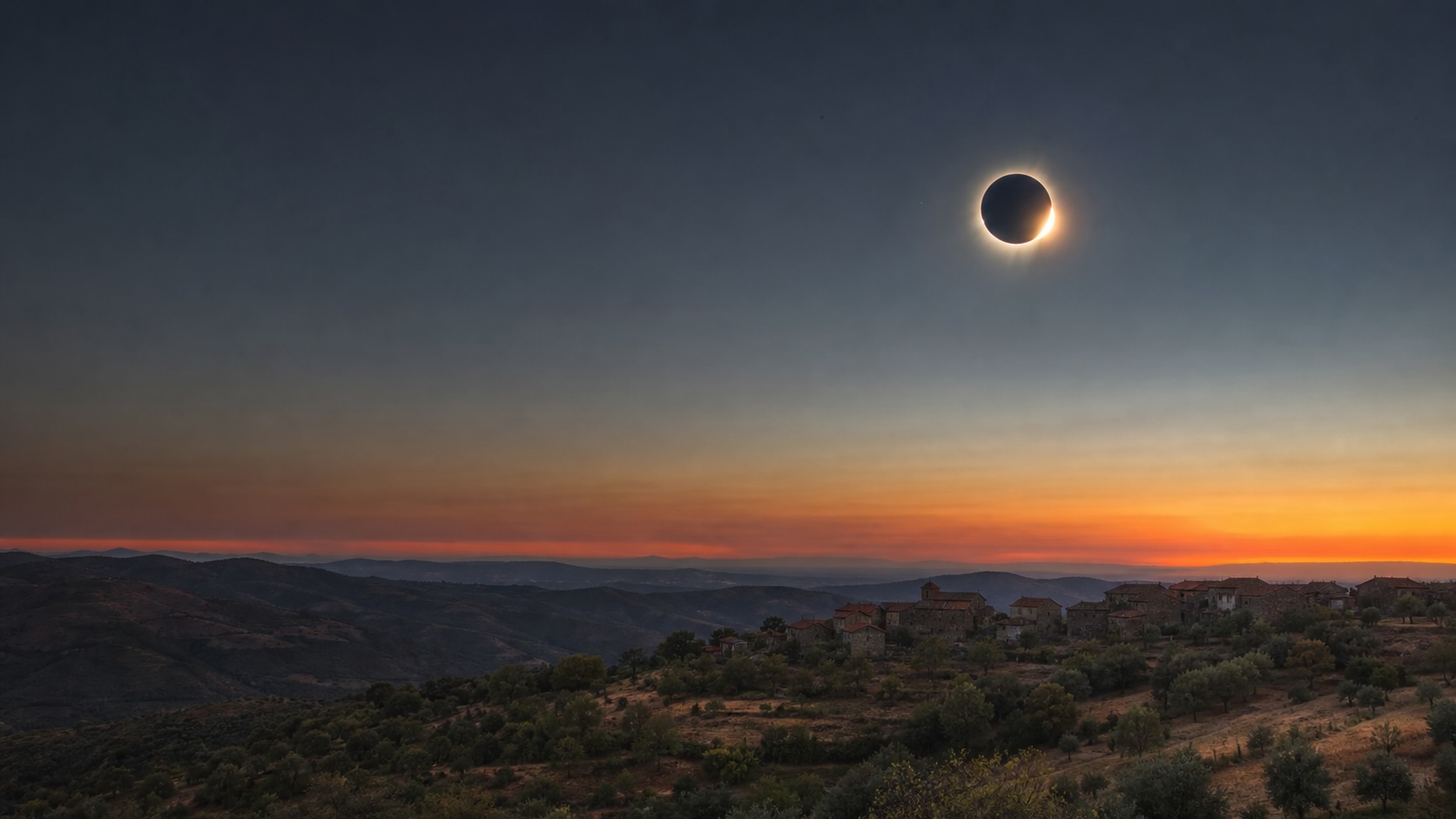
At the beginning, the Moon will appear to take a small “bite” from the Sun. Over the following hour, more of the solar disc will disappear until only a narrow bright section remains visible.
As maximum eclipse approaches, the daylight may take on a cooler and slightly unusual quality. Shadows can become sharper, the temperature may fall, and birds or other animals may react to the fading light.
However, a 95 or 96 per cent partial eclipse is not the same as totality. The remaining part of the Sun is still intensely bright, and the sky will not become completely dark.
This also means that eye protection must be used throughout the entire event on the Silver Coast.
How to watch safely
Never look directly at the Sun without proper protection.
Ordinary sunglasses are not safe, regardless of how dark they appear. Use genuine eclipse glasses or a handheld solar viewer that complies with the international ISO 12312-2 safety standard.
Before using eclipse glasses, check that the filter is not scratched, torn, punctured or loose.
Cameras, mobile phones, binoculars and telescopes also require special solar filters fitted securely to the front of the equipment. Looking through an unfiltered optical device while wearing eclipse glasses is extremely dangerous because the concentrated sunlight can damage both the filter and your eyes.
NASA advises that eye protection may only be removed during genuine totality, when the Moon completely covers the Sun’s bright surface. As totality will not occur on the Silver Coast, viewers here must keep their eclipse glasses on whenever looking towards the Sun. Read NASA’s eclipse safety guidance.
An indirect viewing method, such as a simple pinhole projector, is a safe alternative for anyone without eclipse glasses.
Where can you get eclipse glasses?
Certified eclipse glasses are being distributed through several public information campaigns and organised events across Portugal.
The national Eclipse 2026 website provides information about official activities, viewing events and the availability of free glasses through participating opticians. Registration may be required, and supplies are limited.
Buy or collect your glasses well in advance. Avoid unverified products from unknown online sellers, and do not rely only on an ISO logo printed on the packaging.
A simple plan for 12 August
- Obtain certified eclipse glasses in advance.
- Choose a location with a clear western horizon.
- Check the cloud and fog forecast before leaving.
- Arrive no later than 6:15 pm.
- Bring water, sun protection and something to sit on.
- Keep children supervised while they use eclipse glasses.
- Never point unfiltered cameras, binoculars or telescopes at the Sun.
- Have a second viewing location in mind in case of coastal fog.
A memorable evening on the Atlantic coast
With its beaches, cliffs and open western horizon, Portugal’s Silver Coast could be one of the most atmospheric places to experience the eclipse.
You do not need specialist equipment or a long journey. A safe location, clear skies and certified viewing glasses are enough to enjoy this unusual event.
Mark Wednesday, 12 August 2026 in your calendar now. Find your viewing spot, invite friends and family, and prepare for a very different kind of Portuguese sunset.
Share this:

Discover more from ::Mais:Oeste:TV::
Subscribe to get the latest posts sent to your email.